
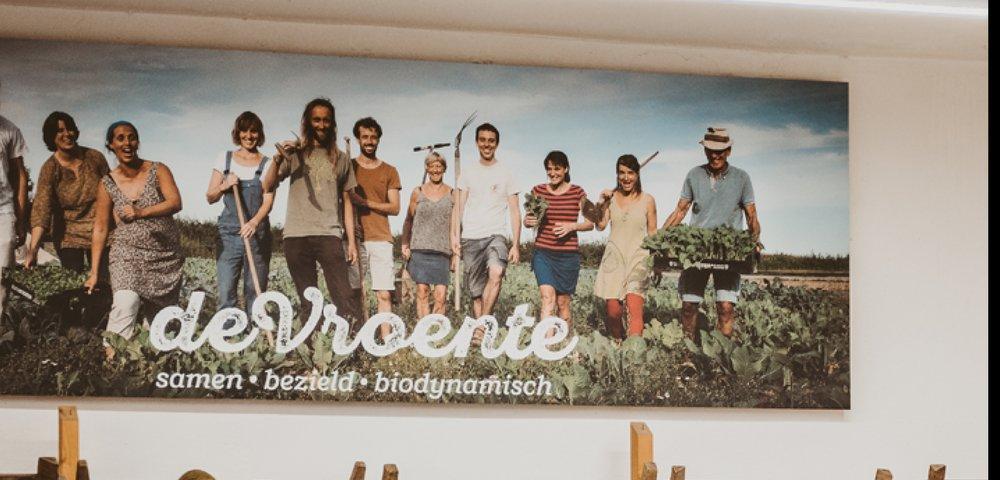
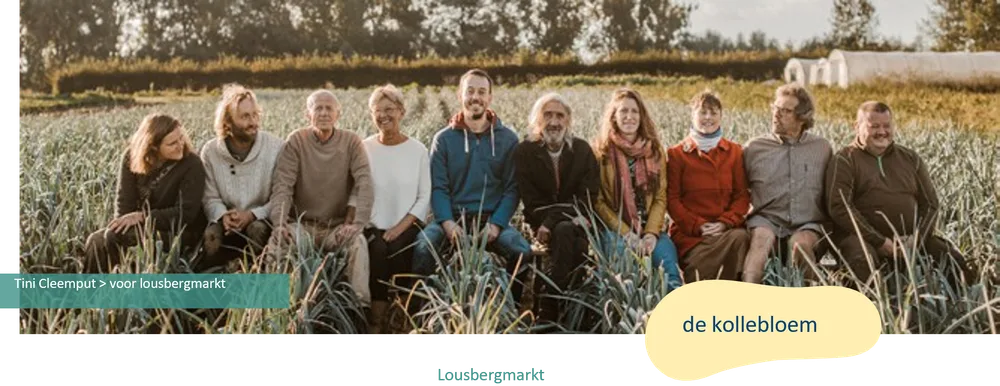
More than 20 years ago, farms Ourobouros, de Kollebloem, and de Zonnekouter established a collaboration under the name De Vroente for the biodynamic cultivation and sale of vegetables and fruit. In 2016, De Vroente launched the Lousbergmarkt together with four other companies from the Ghent area. A remarkable example of collaboration.
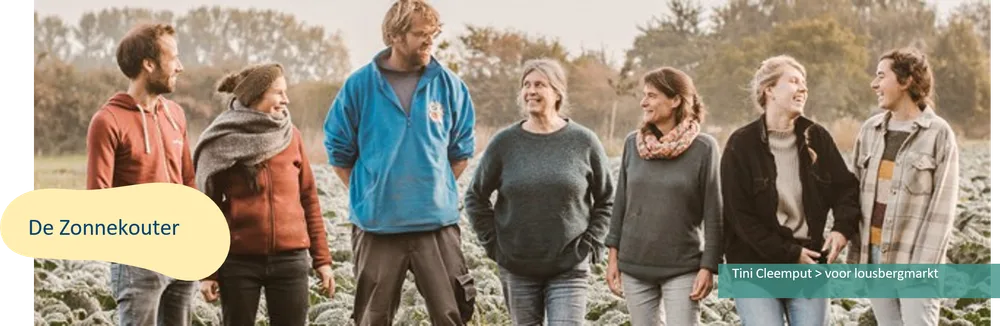
Ourobouros, de Zonnekouter, and de Kollebloem are cooperative short-chain farms from the area around Ghent. Last year, de Vroente, the cooperative in which they each own a third of the shares, celebrated its 20th anniversary. A fine achievement, as not many collaborations are destined for such a long and happy life. The secret clearly lies in breaking taboos and talking about what can be improved.
Three peas in a pod
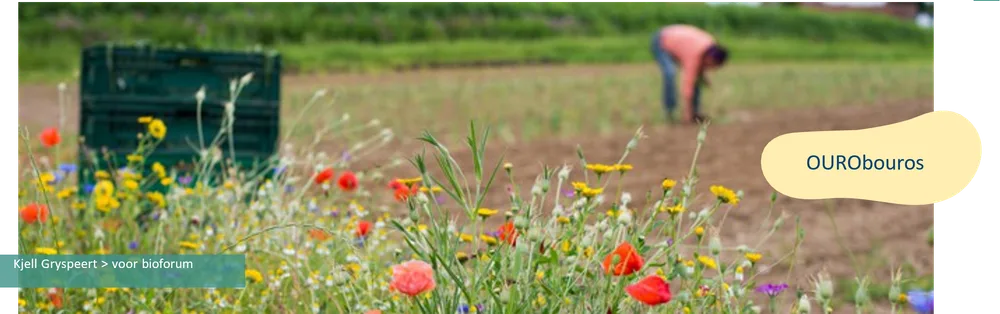
Karel Houdmont founded Ourobouros 20 years ago. As a young start-up with a limited cultivation area and market, he sought support from colleagues. "I thought I could find that at the then South-East Flemish Farmers' Group, but some members advised against it due to internal conflicts. The collective did indeed fall apart, and a while later I was asked by local farms De Zonnekouter and De Kollebloem if I wanted to join their collaboration." That proved to be a good choice, because so many years later, the De Vroente cooperative stands stronger than ever, and a farm shop in the city, the Lousbergmarkt, was even added.
By naming problems, we emerge stronger.
Dare to name problems
"Within De Vroente, we make agreements regarding the cultivation plan, prices, and sales. This way of working enables us to operate more efficiently and offer each other's crops in our farm shop and boxes. This way, for example, we don't all have to grow radishes," says Karel.
Three cooperative companies joining forces in a joint cooperative requires a great deal of organization and, above all, communication. "Many collaborations in the region have fallen through because the farmers' goals were not the same and there was insufficient discussion about, for example, quality or price. We try to avoid those pitfalls. We work together not only for economic reasons, but also because we respect and support each other with knowledge, advice, and practical assistance. If you don't do that, frustrations quickly take over." Yet, it wasn't always smooth sailing for De Vroente either. For instance, generational changes at various farms caused internal tensions that also filtered through to De Vroente. "But by naming the problems each time, we emerged stronger."
Dream becomes reality
Walter, the founder of De Zonnekouter farm, had dreamed for years of one day starting a farm shop in the city with De Vroente. A few months after he passed away in 2016, that opportunity suddenly presented itself. "Cheese dairy Het Hinkelspel moved to a more spacious location and was looking for a tenant for their premises in the center of Ghent. We acted incredibly fast and put together a farm shop in just a few months," says Karel. De Vroente assembled a team to run the shop, they looked for other businesses willing to rent a share of the building, took care of the interior design, and so on. There was no time for subsidy applications, so they tapped into their own resources to finance the start-up. In 2016, the Lousbergmarkt opened its doors, housing five separate shops: De Vroente, cheese dairy Het Hinkelspel, bakery Copain, lunch bar De Bergen, and butcher shop De Heerlijkheid.
Align price and offer
In the meantime, the Lousbergmarkt has grown into a thriving covered market that brings farm products to the city. Pieter Lantsoght, employed by de Vroente since 2020, is responsible for their shop in Ghent. "This shop was a logical consequence of the years of collaboration within de Vroente. By now, it accounts for a significant portion of the farms' sales," he explains. "In the autumn, the three farms come together and finalize the cultivation plans. In doing so, they also take into account feedback from the Lousbergmarkt, such as which products sell well or less well. They make price agreements, to which we, as a shop, then add the margin needed to cover operating costs." The Lousbergmarkt is currently experiencing stable growth, and the de Vroente shop operators benefit from this. After all, 20% of the profit goes to them and is distributed based on the number of hours worked in the shop.
Thanks to our app, we can easily coordinate orders for the three farms.
Thanks to the app
Pieter is well aware that Lousbergmarkt is not the cheapest shop in Ghent. "But our accessibility in the city center and, above all, the wide range of organic, biodynamic, or sustainable food is a major added value for many people." The selection consists of products from their own farms, but is supplemented where necessary with imported products via Food Hub. "We use a color system to give customers insight into what they are buying. Green means a product comes from De Vroente, orange from other Belgian farms, and red from abroad," says Pieter. The De Vroente farms deliver to each other and the shop three times a week. "Each farmer drives past the three farms and Lousbergmarkt once a week, so the work is nicely distributed," Pieter explains. To manage all those orders effectively, the farms have had a special app developed, allowing them to easily keep track of packing slips, deliveries, invoicing, and more. "This way, we avoid having to constantly call each other to coordinate."
To each their own shop
In addition to the cooperative operation of each individual farm and the collaboration within De Vroente, there is also cooperation with other businesses within the Lousbergmarkt. It is no easy task to get everyone on the same page, but it works remarkably well. "Each of the 5 shops in the Lousbergmarkt rents its own section from the owner, Het Hinkelspel, who also runs a shop there," explains Pieter. "Everyone is responsible for their own shop, but there is, of course, consultation. For instance, internal regulations determine the conditions should a shop close and a new one wish to join. We also have an agreement to make maximum use of each other's products in our shops, for example as ingredients for preparations. In the event of overlap, we always check first whether this is acceptable for the shop with the largest selection in that regard." Customers therefore pay separately at each shop in the Lousbergmarkt. "That sometimes caused confusion in the beginning, but by now the concept is quite clear," notes Pieter.
View the whole
Cooperatives joining forces at various levels? Policy is not always geared towards such forms of cooperation. Unfortunately, Karel notices this as a farmer as well: "Because we buy many products from each other, we flirt with the legal standards of a short-chain business. This means we quickly miss out on subsidies. In this way, the government indirectly penalizes small businesses that enter into partnerships with one another. That needs to change," Karel believes.
By viewing us as a single entity, many barriers would disappear.
This text previously appeared in the brochure 'The Power of Cooperation in Fair Food Chains' (ILVO, LLAEBIO, BioForum, CCBT, Voedsel Anders, Steunpunt Korte Keten, 2024). Text: Pennenvrucht. Photography: Tini Cleemput (De Vroente, Lousbergmarkt), Kjell Gryspeert (Ourobouros).