
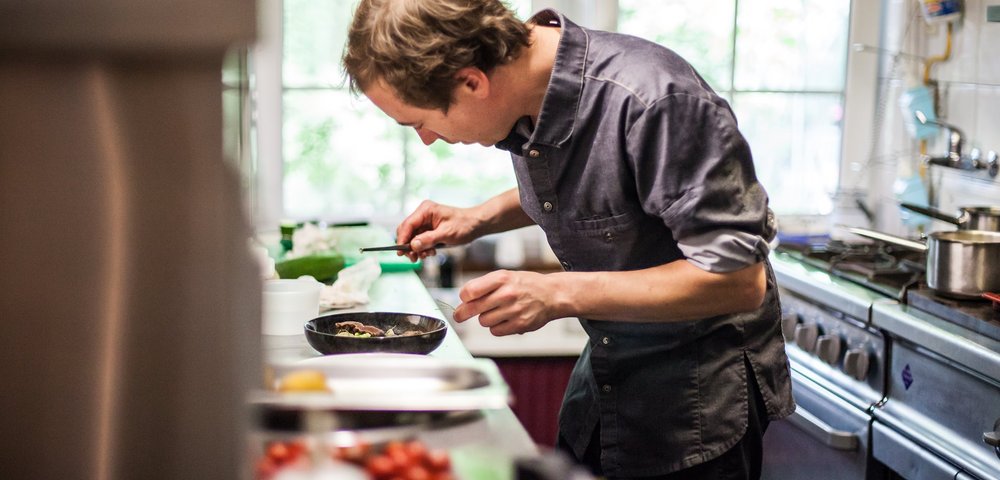
The Ourthe River flows at the end of the street. In Comblain-la-Tour, in the municipality of Hamoir, between the river and the woods that rise behind the village, Sophie Gigot and Nicolas Septon have been running a house since 2017 that operates on a different scale than that of the four seasons.
The old Japanese solar calendar has twenty-four seasons, called sekki, each divided into three five-day periods, called kō. Seventy-two seasons in all, with names like "rice ripens" in early September, or "swallows depart" two weeks later. The restaurant's two menus are called Kō and Sekki. These names reflect a method: cooking on a weekly scale rather than a quarterly one.
Something that only exists during that week
The menu changes weekly, depending on what the producers can deliver and what the vegetable garden yields. In early September, the last of the zucchini arrive with a salsa verde and marigold flowers picked from the garden. The marigold lasts until the first frosts; when they fall in October, the dish disappears from the menu with them, and the next season takes its place.
Sophie and Nicolas have a word for it: the snapshot. Their desire, they write on their website, is to "imprint the fleeting scent of a landscape on your senses." In the short film that director Anthony Florio dedicated to them, Sophie puts it more simply: the menu captures the season, and the cuisine attempts to recreate everything that is available at that very moment, down to the smells and colors of the weather. Most kitchens organize their supplies around a menu. Here, the menu is organized around what grows.
The vegetable garden that writes
Behind the house, the garden serves as both a pantry and a laboratory. Nicolas cultivates herbs, edible flowers, and varieties requested by the menu but rarely offered by wholesalers. In spring, cherry blossoms are macerated for aperitifs; in September, marigolds are used in the kitchen. This only makes sense because the tree and flowerbeds are located just a few meters from the stoves.
The same logic governs what the kitchen refuses to throw away. Brewery spent grain, that malt residue that breweries discard in large quantities, becomes a "faux chocolate" conceived as a local alternative to cocoa. Peelings, tops, and wilted flowers find their use, some immediately, others preserved for later. Sophie sums it up another way: what was once waste has become an ingredient, to the point that the kitchen sometimes runs out.
The bread, finally, is made fresh daily with sourdough, shaped by Nicolas. Everything that can be grown, processed, or kneaded on site is, and that's what this establishment means by local.
Sophie, or the other half of taste
Sophie sums it up in a nutshell: the restaurant's name is a testament to the two of them. Nicolas cooks, Sophie hosts, and the culinary experience doesn't end at the kitchen door. Sophie curates the wine pairings. Alongside this wine list, the restaurant offers a selection of flavored waters that complement each course. These are the creation of Sam, whom Sophie and Nicolas describe as the most inquisitive and dedicated of their chefs, and they offer guests who don't drink alcohol a complete pairing rather than just a glass of water.
In the dining room, Sophie explains. On each table, a small card indicates where the day's produce comes from and who grew it. It's a table-level representation of what the kitchen does all week: making visible the chain that leads from field to plate.
A house that takes its producers
Sophie and Nicolas work with a network of small producers and artisans in the Ourthe Valley and the surrounding plateaus. "Everyone contributes," says Sophie. When the restaurant joined a network of producers and restaurateurs this year, it brought three of its suppliers on board. It's a way of understanding the business, which places the restaurant in the middle of a chain rather than at the end.
This is evident even in the smallest details. The restaurant's website asks guests to leave without disturbing the peace of the village and sets closing times to ensure the staff gets a good rest. A cuisine that respects the rhythm of the seasons also respects the rhythm of people.
A message before a restaurant
Sophie explains that she and Nicolas have reached a point where the message matters more than the restaurant itself. A customer who leaves without having grasped it, even if satisfied with their meal, remains, in their eyes, a missed opportunity.
This message boils down to a simple idea, which she expresses in her own way: it's not necessary to serve lobster to create a gourmet menu. What grows locally, prepared with care and served at its peak, is enough to create a truly excellent meal. Therein, according to her, lies their true wealth: proving that ambitious cuisine can begin with simple ingredients.
The five-day season
The seventy-two seasons explain what is happening here. Dividing the year into five-day periods means forcing oneself to observe: the vegetable garden, the sky, deliveries, the producers. It's an enormous constraint for a kitchen, and it's precisely what makes it alive: nothing served tonight was available a month ago, and nothing will be available a month from now.
In Comblain-la-Tour, the river still flows along the end of the street. The map, however, will have changed next week.
Video: Anthony Florio https://app. oriri.food/be/chatelet/service-provider/anthony-florio-147