
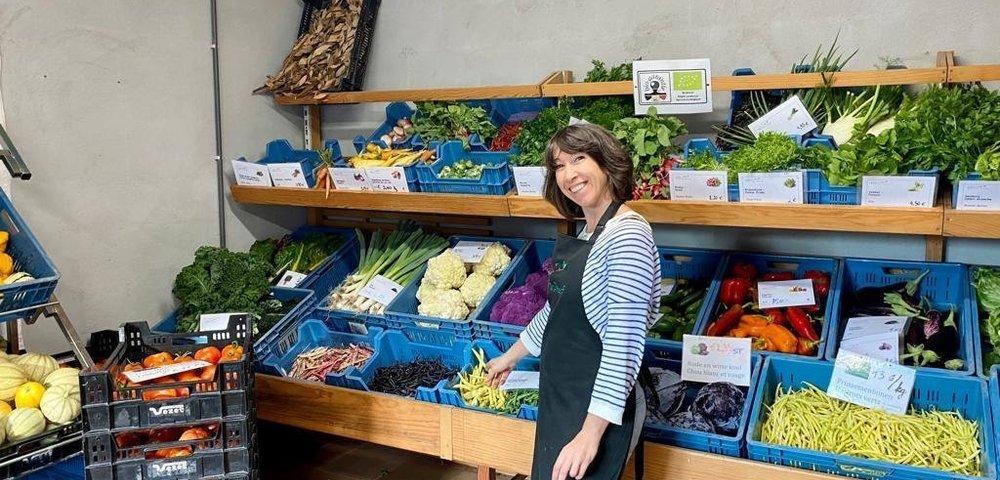
On Saturday morning, the farm shop on Prinsendreef in Meise is packed. People shuffle past crates of chicory, purslane, pears, and Jerusalem artichokes, with a basket in hand or a son on their hip. Anyone looking at the labels notices something unusual. The vegetables side by side come from five different farms. Some were picked a few hundred meters from the shop, others in Asse, Opwijk, or Aalst-Baardegem. Yet everything lies here together, in the same shop, with the same people behind it.
That is no coincidence. It is the heart of Samen op Dreef, a social cooperative in which Fien Sambaer, Guy Mouchart, and the farmers from four surrounding farms are setting up a shared structure for what they were each already doing separately: organic, ecological, and on a small scale. By collaborating on logistics, packaging, marketing, and sales, they are building something that rarely succeeds in practice: a short supply chain that does not crack under its own ambition.
The problem under the short chain
Anyone wishing to work on a small scale and organically quickly runs into the same hurdles. A farmer with three hectares of vegetables does not have the capacity to send a van to Brussels every day. An orchard does not have the time to market alongside pruning, harvesting, and processing. And a farm shop that is only open two days a week lacks the volume to build a regular clientele.
In an industrial chain, a large distributor solves that. But with that, the very part that matters most in a short chain also disappears: the face behind the product. The certainty that the price on the plate is a fair price for whoever grew it. The seasonality that slips away as soon as someone has to run a wholesale business.
As a result, the short supply chain often finds itself in a dilemma: too large to remain purely local, too small to survive logistically.
The answer to five hectares
At Hof ter Dreef, the historic site on Prinsendreef, Fien and Guy sought a different solution. Instead of choosing between scale and locality, they brought five farms together under a single cooperative structure, while each retained its own identity and land.
Hof ter Dreef itself grows vegetables and fruit on three hectares of sandy loam, with high-stem orchards where free-range chickens scratch among the trees. Seizoensmaak works with unheated greenhouses for winter leafy vegetables. Hof van Piemont creates natural nesting sites for predatory insects and birds in the orchard. De Seepscherf supplies organic meat through a partnership with Hof van Dorset, featuring Hereford cattle, Poll Dorset lambs, and Oxford Sandy and Black pigs living outdoors on herb-rich pastures. And the cooperative itself provides what each of these companies would struggle to arrange individually: a shared sales channel.
That sales channel takes three forms. The farm shop in Meise on Wednesdays and Saturdays. A weekly pick-up point at the Tour & Taxis Food Market in the Gare Maritime in Brussels, where rural produce and urban eaters literally meet. And a digital webshop, built with linked.farm , where the farm of origin is listed for every product. Chicory from Hof ter Dreef. Lamb's lettuce from Seizoensmaak. Jam from De Seepscherf. No uncertainty about origin, no anonymous shelf.
What cooperative means in practice
The word cooperative is often used loosely. At Samen op Dreef, it has concrete consequences.
The five companies share machinery and logistical materials. A tractor standing idle at one farm can be put to work elsewhere. A refrigerated truck transporting the harvest from Aalst-Baardegem to the store takes packaging along on the return journey. Expertise flows back and forth. A farmer who has mastered a technique for mixed cropping or agroforestry shares it with the others. Surplus fruit from the harvest is not wasted but is processed by the farmers themselves into syrups, fermented products, jams, and quince jelly.
The second part concerns who the owners are. Customers can become members by purchasing a share. Anyone who contributes at least four hours per month to the operation receives two votes in the General Assembly. Those who are sympathetic members receive one. This blurs the distinction between eater and farmer. People who buy their vegetables can also get their hands dirty and help decide the direction.
The third aspect is financial. Those who subscribe to vegetable boxes pay in advance for the season, in packages of 25 or 40. That may seem like an administrative detail, but it is structural. It means that farmers know in February what they can harvest in July. Seeds and compost are paid for before a hoe goes into the ground. A failed harvest due to frost or flooding is distributed across the community, rather than bringing down a single company. It is a form of shared risk that has long been lost in the industrial chain.
What the eater feels about it
For those who step into the farm shop on Saturday, those structures are largely invisible. What remains is something simpler. A weekly newsletter reporting on how things are going in the fields, even when they are going badly. Workdays where cooperative members and local residents come together in the fields. Pruning courses in the orchard. Cooking workshops in the shop. Guest lectures that Guy gives to schools on climate and collaborative entrepreneurship.
They are small things. But together, they build something that has been designed away in the industrial model: a form of control that does not rely on a label, but on presence. Anyone who stands in the field once a month does not need to be told what regenerative agriculture means. They have the mud under their nails.
Replicable, not unique
The beauty of Samen op Dreef is precisely that it is not inimitable. The scale model does not depend on a single charismatic farmer or a single unique location. It is a structure. Five businesses that share their supply chain without sharing their land. A farm shop as a shared showcase. A pick-up point in the city as a bridge to the urban public. A webshop that keeps the origin of each product visible. A cooperative model in which diners can become co-owners.
It works at Prinsendreef. The question is not whether it would work elsewhere, but who is willing to build the logistical backbone. Because that is ultimately what has been created here. Not a network of isolated farms that happen to be located in the same region, but a shared infrastructure that every farm can leverage. A short chain that no longer collapses under its own weight.