
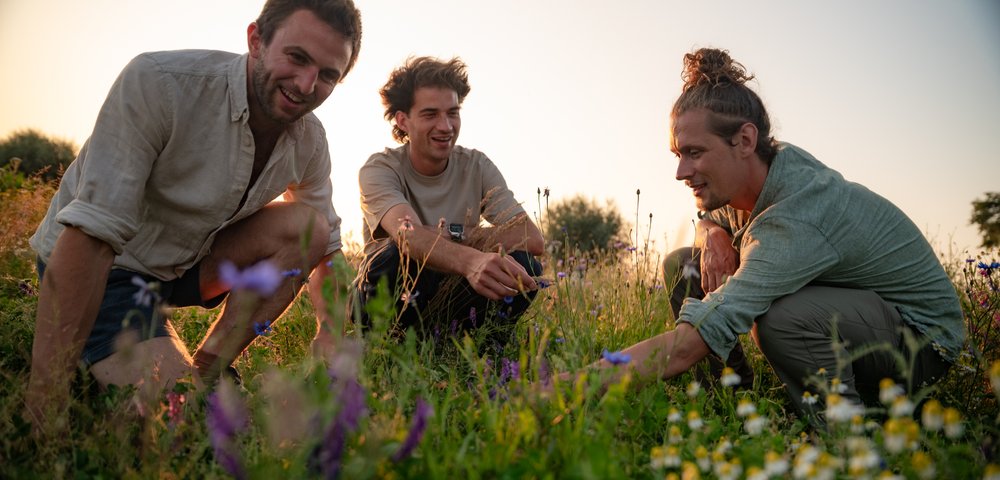
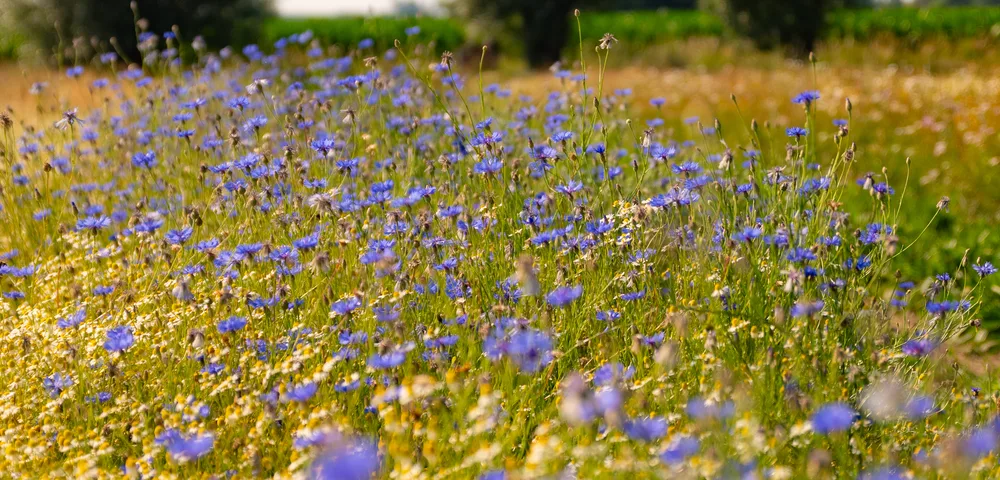
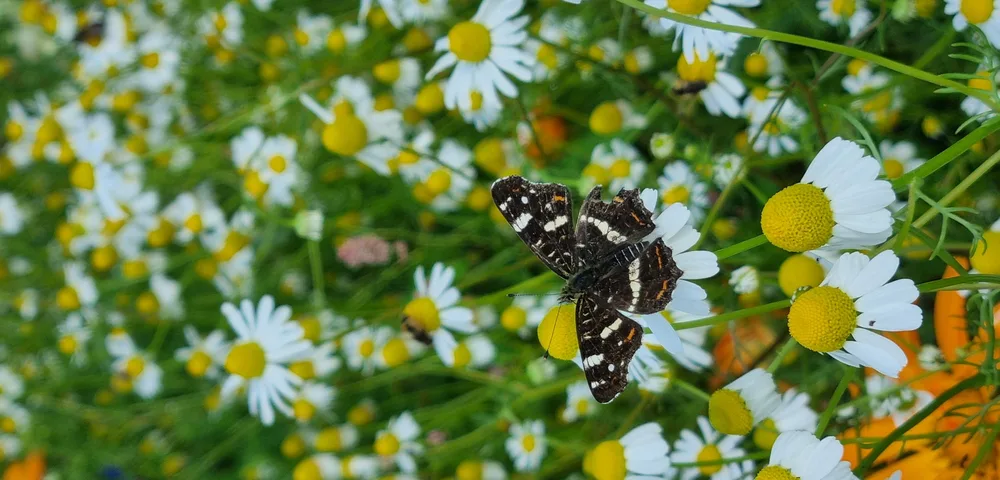
On one side of the path stands fodder beet in straight rows, his father's field. On the other side, half a hectare of cornflower, chamomile, marigold, and yarrow undulates together. Anyone walking past in the summer hears the difference before they see it. Above the herbs hangs a persistent rustling of wings.
Brecht Herteleer is the seventh generation on this farm in Lievegem. He always wanted to be a farmer, but at the same time encountered the limits of upscaling and monoculture. In 2021, as an experiment, he sowed a strip with what most people call weeds. Together with plant expert Torsten Martens and agricultural engineer Anthony Denayer, he built a system of (un)weeds around it: sowing wild plants, harvesting them, and processing them into tea, so that a revenue model is attached to the restoration itself.
What moved away
The figures behind that recovery are stark. In the 1970s, the Institute for Nature and Forest Research counted around 75,000 breeding pairs of skylarks in Flanders. In the most recent count, that number was between 6,000 and 8,000, and a third of them now breed in heathlands rather than in the open fields. Of the 75 butterfly species that Flanders once had, twenty have become regionally extinct, well over a quarter. The Flemish Red List of wild bees from 2025 lists 340 species, of which 35 have disappeared and 101 are threatened.
The decline is also reflected in weight. Between 1989 and 2016, German researchers weighed the catch from their insect traps in 63 nature reserves. At the end of that period, the total biomass of flying insects had decreased by 76 percent, and by 82 percent during the summer months. The study by Hallmann and colleagues was published in 2017 and has since been widely cited as a measure of what is happening in the landscape.
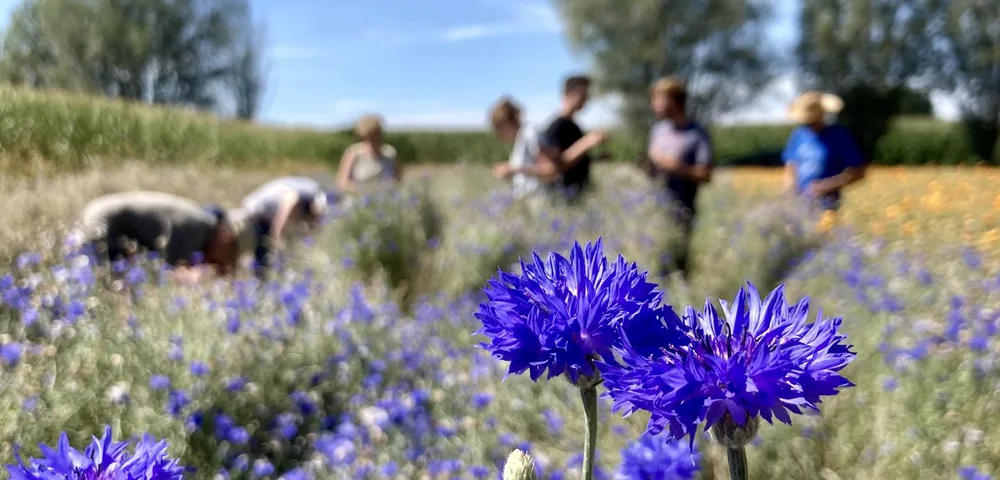
The cornflower tells that same story on a small scale. It belonged in the grain field, among the stalks, and disappeared from it within a few decades. Better seed cleaning, denser crop stands, chemical weed control, and heavier fertilization pushed it aside, and after 1970, maize displaced grain cultivation on many plots. Today, it is listed on the Flemish Red List as declining. What Herteleer sows has therefore been literally brought back.
Why it matters
Biodiversity sounds abstract until you look at it by species. Caterpillars feed on a limited number of host plants, and butterflies lay their eggs only on them. The swallowtail needs umbelliferous plants: wild carrot, fennel, dill. The peacock butterfly lays its eggs on stinging nettle. If you sow those plants, the butterfly will follow. If you leave them out, it stays away, no matter how rich the rest of the field is.
A whole chain hangs above those insects. Seed- and insect-eaters like the goldfinch and linnet find food in such a field, and above them the kestrel hunts. After just one summer, a kestrel circled above the herbs of Herteleer.
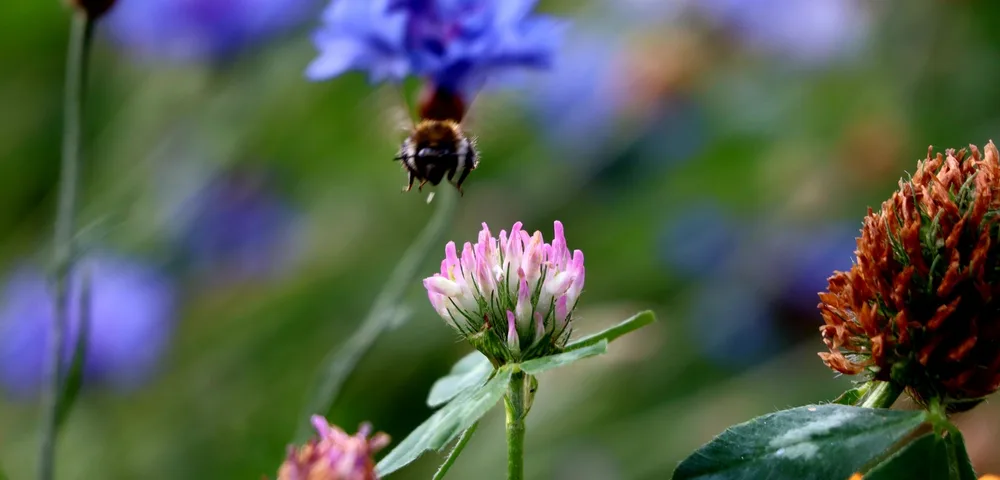
That chain also has an economic side. 84 percent of crops in the European Union are partly dependent on animal pollination. In Belgium, this accounts for approximately 11 percent of food crop production, with an estimated value of 252 million euros per year. Additionally, the INBO calculated that 62 percent of all wild plant species in Flanders require pollinators, while 38 percent of the pollinators themselves are threatened or have disappeared. Furthermore, an analysis of 35 studies found that pests remain under control about 16 percent better in fields with flower strips, because predatory insects overwinter and hunt there.
In 2019, the global panel on biodiversity IPBES identified land-use changes as the primary cause of species loss, ahead of exploitation and climate change.
More than a third of the Earth's land surface is devoted to agriculture and livestock farming. This immediately makes the arable land the place where there is the most to gain: restoration limited to nature reserves leaves the majority of the landscape untouched.
The half you don't see
The second half of the story plays out beneath the field. More than a quarter of all species on Earth live in the soil, from bacteria and fungi to earthworms. In grassland, earthworms dig an estimated 400 to 500 meters of tunnels per square meter, which can increase water retention capacity by up to 80 percent. Approximately 85 percent of plant species live in symbiosis with mycorrhizal fungi, which supply water and nutrients in exchange for sugars. Aboveground and belowground life sustain each other.
That soil is under pressure. The organic carbon content in Flemish agricultural soils has been declining since 1990, partly due to the conversion of grassland to arable land and the decreasing use of animal manure. The first large-scale carbon measurement in fifty years, carried out by the Department of the Environment together with INBO and ILVO at nearly 2,600 monitoring points, mapped out what this means: arable land contains approximately 110 tonnes of carbon per hectare up to one meter deep, compared to 140 to 150 tonnes under grassland, forest, and nature. On sloping arable land in the Flemish loam region, on top of this, one to ten tonnes of soil per hectare is washed away annually, in exceptional cases up to one hundred tonnes. The picture is along the same lines at the European level: the European Commission estimates that 60 to 70 percent of soils in the Union are in poor condition, and since December 2025, there has been a European soil monitoring law that obliges member states to systematically monitor this.
Recovery is possible, and it is slow. ILVO calculates that stable soil carbon builds up over decades, while degradation occurs about twice as fast. Roots play a leading role in this: carbon entering the soil via roots and root exudates remains up to three times more stable than above-ground crop residues. A field that remains covered throughout the season with deep-rooted and varied-rooted plants continuously nourishes soil life, allows rain to infiltrate, and stays where it is. The difference compared to a field that lies open for months after the harvest is particularly visible in winter, when rain on bare ground carries away the finest particles, and it is precisely these particles that retain the carbon and nutrients. In this logic, a plot that flourishes for four consecutive years is built up just as much below the ground as above.
Measuring what comes back
In the field in Lievegem, small yellow dishes of water stand among the herbs. Insects fall into them, and researchers collect them. This is how HOGENT and Natuurpunt measure which plant mixtures attract which species. Meanwhile, 204 species of butterflies have been counted on the test plot, alongside bees, bumblebees, and hoverflies. Researcher Greet Verlinden from HOGENT points out their dual role in pollination and pest control. The swallowtail, rare in the region for years, has reappeared there. Herteleer and Martens studied agricultural and biotechnology themselves, and are happy to bring the researchers into the field.
In addition to the low-growing herbs, the team planted a first border of shrubs and trees: sorrel, sea buckthorn, elder, and apple trees. Such a structure from low to high mimics a forest edge. Each layer attracts different species, and the roots work at different depths. Above ground, this provides shelter and shade; below, leaf litter and organic matter. By comparison, the Ferraris map of 1778 showed approximately 130,000 kilometers of wooded edges, hedges, and rows of trees across Flanders. Only a fraction of that remains today, and with those structures disappeared the shelters attached to them.
From half a hectare to more
Meanwhile, the team also sows for other farmers, provides the knowledge and seed, and buys the harvest. One 40-gram tea bag represents one square meter of sown field. By 2025, around 500,000 cups had been sold, and the tea was available at over 250 points of sale—since that autumn, also in some 150 Aveve stores.
From a policy perspective, this aligns closely with what Europe requires. The EU Biodiversity Strategy for 2030 aims for at least 10 percent of agricultural land to feature landscape elements that support species richness, and the European Nature Restoration Act stipulates that the decline of pollinators must be reversed by 2030. In Flanders, nearly 3,000 farmers entered into a management agreement with the Flemish Land Management Agency in 2024, together accounting for 662 hectares of flower strips. Half a hectare in Lievegem pales in comparison, while simultaneously demonstrating what such a hectare looks like when measured.
The soil beneath that field needs decades to rebuild what it lost. The insects above needed a summer.
A film by Jonas Buysens, Buzzup Creative”, together with (On)kruid.