Resistance does not begin with big words.
Resistance does not begin with big words.
but with small deeds
like a storm with a soft rustling in the garden
or the cat that gets a crazy idea in its head
like wide rivers
with a small source
hidden in the forest
like a sea of fire
with the same match
who lights a cigarette
like love with a glance
a touch something you notice in a voice
ask yourself a question
That is where resistance begins
and then ask that question to someone else.Remco Campert
You regularly see the result of 'neighbor bread'—the loaves coming out of the oven—passing by here. Today, I want to take the time to explain the 'why'.
'Resistance does not begin with big words,' the poem by Remco Campert that I first read around the age of 16 (thank you, #suusdeepee), unconsciously took root in my actions and thinking. Professional choices were guided by this, as I chose to work with refugees and young people from precarious backgrounds over the past fifteen years. These are target groups that are reviled rather than loved by policy and in public discourse. I viewed my small daily acts as modest forms of resistance.
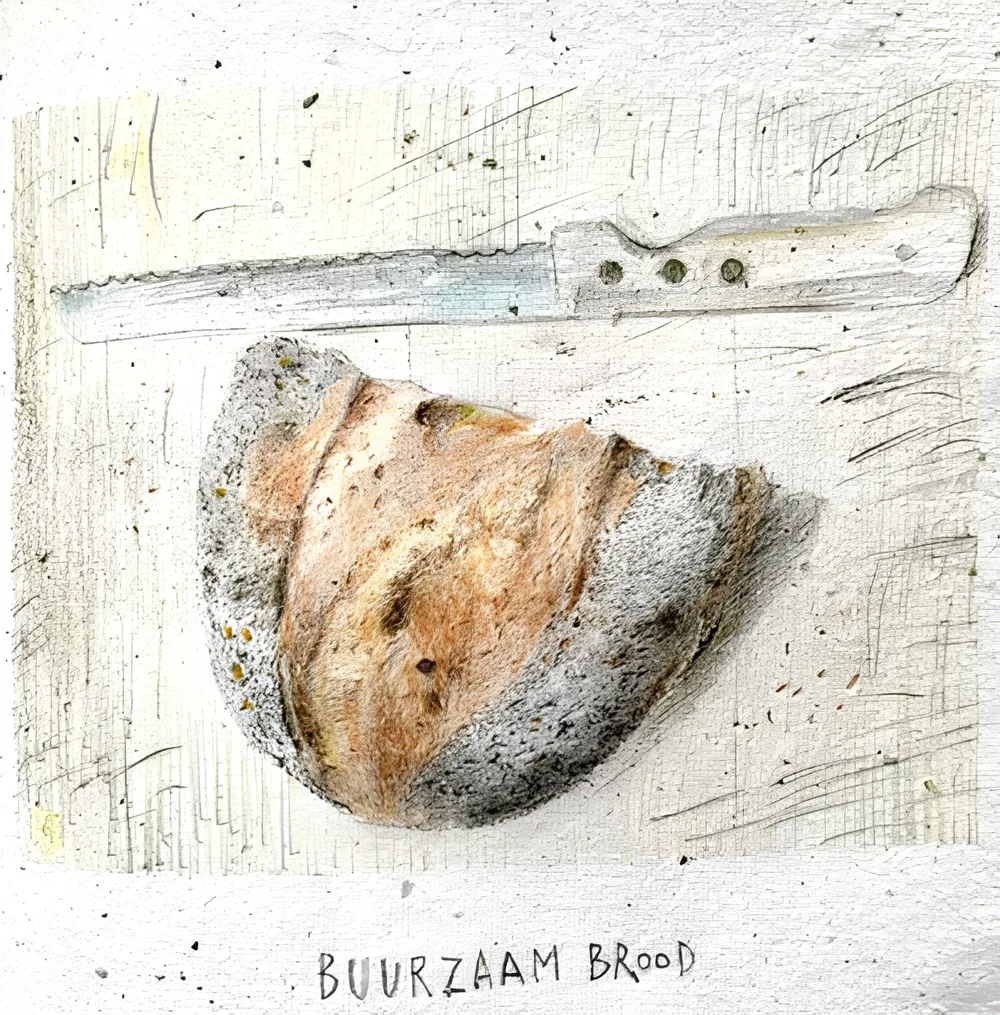
A seemingly insignificant moment two years ago—a car breakdown that forced me to call on the help of neighbors in my relatively new neighborhood—led to a new professional choice, a new form of modest 'resistance,' namely baking my 'neighbor bread.' I thanked my as-yet-unknown neighbors with a loaf of bread and was asked to continue baking it, for neighbors and neighbors of neighbors, giving the faces in the street a name and a story at last. The drawing of the 'neighborly bread' made everything fall into place (thank you, #atelier vero beauprez).
The bread that ends up in your kitchen is the result of a chain of choices, from farmer to miller and baker to consumer, each of whom has individually made a decision that goes against the norm. The norm that is defined on the basis of efficiency and financial return.
For centuries, the farmer selected his own grain. He kept seed from the best ears, sowed it again, and generation after generation, the crop adapted to its soil and climate. Every region had its wheat, and every wheat its bread. In the twentieth century, official variety catalogues determined which seed could be traded, and this led primarily to modern, pure lines: genetically uniform, short-straw, high-yielding, and, above all, selected for a gluten network strong and tough enough to withstand mechanical processing. The farmer continued to sow, but what he sowed had been decided by others. Here and there, however, farmers are rising up to defy this by opting for population wheat, a living mixture of thousands of plants that differ from one another, growing together in a field, sown anew each year from their own harvest and thus becoming a little better adapted to that one spot each year. If a wet spring, a fungus, or a heatwave occurs, some of the plants perish and others take over. The field responds. A pure line cannot do that, because whatever one of her plants fells, she fells them all. A population exists only as long as a farmer sows, selects, and passes it on, and it is unusable as an industrial product because it is never the same twice. Farmers like the people from #De Kollebloem and #Ourobouros make such decisions.
Whoever grinds these grains decides what remains in the flour. The germ of the wheat kernel contains the oil, and oil becomes rancid. Whoever removes the germ obtains flour that keeps for months and can be transported over long distances. The roller mill does exactly that, and so shelf life became more important than what was lost: the germ, and with it a large part of the vitamins, minerals, and flavor.
The water of the Zwalmbeek in Sint-Maria-Latem turns the millstones of the IJzerkotmolen, and the stones grind the whole kernel, including the germ and bran, causing the flour to keep for a shorter time. Furthermore, the flour in the bag is the result of grinding a single type of grain from one specific farmer, and not the product of a mixture of domestic and foreign grains that would make the flour anonymous. Emmanuel and Jochen from the #IJzerkotmolen make this decision.
In the bakery, the primary focus over the past century was on saving time. The time required to make a loaf of bread was reduced to just a few hours, using plenty of yeast and so-called 'improvers'. The result is a light product whose taste and appearance remain consistent. However, more and more bakers are choosing to allow time into the baking process. For instance, the process from the last feeding of the sourdough starter to taking the loaves out of the oven takes thirty-six hours. What happens in the dough during that time cannot be achieved by an improver: phytic acid, which binds minerals like iron and zinc in whole grains, is broken down, allowing the body to absorb those minerals. Proteins are pre-digested, the gluten network becomes lighter, and fructans—the carbohydrates that make many stomachs feel heavy—largely disappear. I have decided to embrace time as a necessary factor in the bread-making process.
I sincerely believe that the human connection that makes up the chain of this bread is stronger and more valuable than a label, and this idea is supported by a recently developed platform like # oriri .
Finally, you, the people who choose neighborhood bread, form the necessary last link in this entire process of decisions that go against anonymity, uniformity, and haste. Without you, there would be no 'neighborly bread'. Thank you.