
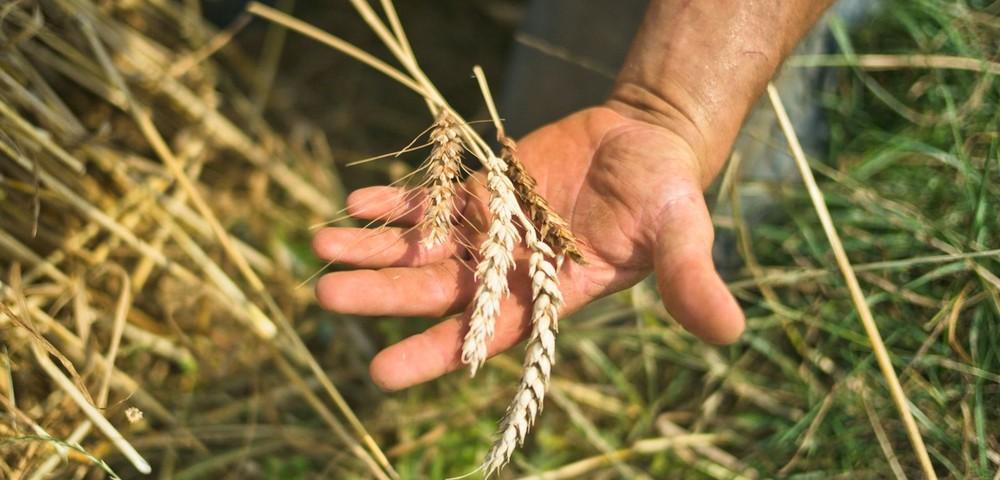
The Little Red of Brabant. Until the 1970s, it stood waving in the fields in and around the Pajottenland, but today this original wheat variety is nowhere to be found, nor, say, the Zeeland White and the White of Flanders. Yet our Little Red is a landrace, a grain variety native to the region that was traditionally cultivated for lambic. The dream now is to start using the old varieties again.
To begin with: how exactly did we lose those varieties? It is a long story. Anyone still harboring the romantic notion that every farmer stands on the land with their bones and works the soil with gnarled hands needs to be brought back down to earth. "Farmers are becoming managers more and more these days," says Lucas Van den Abeele, who shaped the local 3 Fonteinen Grain Network in and around the Pajottenland. "There is often no longer any direct contact with the soil: at best, they still see the land from their tractor, but they are just as likely sitting at their laptops filling out Excel spreadsheets. They produce for the global market and do not know where their harvest is going."
Will the grain be used for beer or bread, for animal feed, the starch industry, or biofuel? Today's farmer has no idea. Will it stay in Belgium or go to Poland or Kazakhstan? No idea. That used to be different, but for that, we have to turn back the clock half a century.
Higher yield with less manpower.
Up until the Second World War, the majority of the population still had a connection to agriculture. Even if you weren't a farmer yourself, you had one in the family. And if not in your own generation, then it was your grandparents. "The connection to the land still existed," Lucas further explains. "People knew that strawberries were impossible at Christmas. That is different now, because they are always gleaming in the supermarket."
People knew that strawberries were impossible at Christmas. Now that is different, because they are always gleaming in the supermarket. Lucas Van den Abeele
The war had floored Europe, and afterwards it wanted to modernize agriculture along American lines. In France, the workforce in the fields had been nearly halved because so many farmers' sons had been killed in action in every village. Moreover, the factories poached many people with the (justified) promise of better wages. "The farming business collapsed. To obtain sufficient grain, we were dependent on imports from Russia and the United States at that time. No one felt good about that. We were not only faced with a shortage, but also with an inferiority complex."
Sicco Mansholt, the first European Commissioner for Agriculture, was a Dutchman who had lived through the war winter and experienced the misery of food rationing firsthand. It was with the best intentions — "No more hunger!" — that he began to promote industrialization and economies of scale. His definition of successful was 'more': higher yields with less manpower. "Get big or get out" became the mantra for the first Common European Agricultural Policy in 1958.
Mansholt, who had himself been a farmer in Groningen, was convinced that a farmer should receive a decent income. Lucas: "But he completely failed in that regard with his policy. Farmers' income never rose to the level of an unskilled factory worker. A worker was given fixed hours and leave, but everyone continued to consider it normal that a farmer essentially works all the time, day and night if necessary."
Farmers and grains in formation.
To this day, we still feel the consequences of that. The European subsidy that farmers receive nowadays is actually a subsidy to the agro-industry: farmers are paid extra so that they can sell their grain below cost price. A farmer sees no customers, only technical consultants who tell him what to buy and when to invest to please the tax authorities. He receives advice from the same people who also sell the machinery and seeds and who are indirectly responsible for the loans as well.
"They give advice, but actually they are salespeople," says Lucas. "That situation is absurd and stifling. Farmers are no longer players, but playthings of greater powers. We call that the lock-ins of modern farming existence. There is no easy way out of that situation, because everything is interconnected."
Modern wheat and barley varieties are 'pure line varieties'. That sounds nice, but homogenization destroys so much.
It is not only farmers who have to toe the line. Nature itself has also been constrained by industrial agriculture. For decades, everything has revolved around uniformity. Modern wheat and barley varieties are 'pure line varieties'. That sounds good, but in reality, homogenization destroys a great deal. It is one of the fundamental problems that agroecology aims to address.
Agroecology? That is the science that investigates how our food system is actually an ecosystem in itself: farmers, processors, and consumers all influence one another. If things go badly on the land, they go badly for the farmers too, and vice versa. And without political decisions, the status quo remains unchanged. That is why it is also a social movement and a practice.
Marjolein Visser is a professor of agro-ecology at the ULB in Brussels. She was Lucas's supervisor when he conducted research for his thesis. "To register a variety on the European variety list, it must meet three criteria: Distinctness, Uniformity, and Stability. But the U in those famous DUS criteria is increasingly interpreted as genetic uniformity," she explains. "It is a complicated story, but it boils down to the fact that processors of beer, bread, or animal feed expect exactly the same product, with a protein content that is identical down to the decimal point compared to last year. Only in this way can they standardize their recipes for the global market. There is no room for variation."
"That is not interesting to nature," she adds. "It feels more comfortable with subtle differences in the genetic material." If disease or pests strike, some plants will survive anyway and ensure the future of the variety because they are resistant. It is all quite a coincidence. But the chemical industry does not like that coincidence.
It is not of interest to them that varieties are protected in a natural way, because then they sell fewer pesticides. Look, all those modern varieties are sprinters. The old landraces were long-distance runners: they yielded less, but lasted longer. Take climate change, for example: if you let nature take its course, it would find a solution more easily for higher temperatures and altered soil. You can't just destroy a variety that is genetically diverse.
The old landraces were long-distance runners: they yielded less, but lasted longer. Marjolein Visser
In the past, a farmer used part of the harvest as seed for the following year and also exchanged it with his colleagues, which benefited variety. Today, while it is permitted to reuse seeds, selling them is not. In contrast, there are the so-called F1 hybrids, the ultimate realization of the agro-industry. These are seeds with 'non-stable genetic uniformity'.
Professor Visser clarifies. "If you sow F1 hybrids, they yield a perfect harvest for one year. But if you reuse the seeds from that first harvest, the yield immediately drops. Everything you sow again will behave completely unpredictably and degrade." Self-destructive nature, in other words. This ensures that a farmer has to pay the global agro-industrial companies for new seed year after year.
The Holy Grail of grain.
In that system, there has long been no place for that Little Red of Brabant, which has been replaced by other varieties without anyone noticing — except for a few dreamers. Armand Debelder knew very well that the varieties the lambic brewers worked with at the time had disappeared, but he could not simply solve that. After all, farmers and brewers had grown apart. That changed in 2018.
Pajot farmer Tijs Boelens, the millers of the old Flietermolen in Tollembeek, Lucas (then still a thesis student), and Brewery 3 Fonteinen joined forces to launch the Grain Network. Their goal? To foster contact between farmers, bakers, and brewers within a local network. They wanted to break the vicious cycle of industrial agriculture, restore old landraces, and, above all, strengthen the bond between the various players in the grain chain. Just over a year later, ten farmers had already joined the venture.
Everyone praises geuze as a regional product. So surely it is only logical that the grain comes from here too?
In the meantime, Lucas has set out to search for the landraces in seed banks all over the world. The seeds have been frozen there for decades, such as on the Norwegian island of Spitsbergen. There, they lie protected for eternity under a thick layer of permafrost. He has not yet found the holy grail of the Little Red, but in an American seed bank, he did find eleven old varieties that originally come from Brabant.
Of those eleven, he ordered five grams each — less than a handful. He manually planted each seed in the ground at farmer Tijs's farm in Pepingen. Tijs tends to them with the utmost care so that the first harvest yields a kilogram. And so on. After five years, the first 300 kilos of wheat can come from this, enough to fill a barrel of lambic.
Farmers in the Grain Network receive a fair price for their grain, and they finally know again what it is used for: delicious lambic. Experimentation is now the order of the day, to find a variety that performs just as well in the field as in the barrel. Everyone praises gueuze as a regional product, so surely it is only logical that the grain comes from here too? If the story holds true, the beer will taste better as well; everyone in the network is convinced of that.
A necessary network.
Meanwhile, twelve Brabant farmers are part of the Grain Network, all within 25 kilometers of the brewery. That is not a strict boundary, as long as there is direct contact between the participants. Within tractor distance or something like that; it will sort itself out. But there are two other ground rules.
First, we use only organic grain for the beer. Second, the partners must work together. That sounds soft, but it is necessary. Farmers need resilience when disaster strikes. In the event of a price crisis, water shortage, crop failure, or a sudden death, a strong network of people makes all the difference.
Farmers must work together. That sounds soft, but it is necessary. They need resilience when disaster strikes.
"It's about people who really know each other. That informal aspect is important," emphasizes Lucas. "I invite my colleagues from the brewery for field visits, bring the farmers here, and also ensure that the farmers stay in contact with each other. My job is unique because no one recognizes the importance of networking, and therefore no one wants to pay for it. That is why many other projects fizzle out once they are past the research phase. Here at Brouwerij 3 Fonteinen, we see things differently."
In the past, a farmer was often a brewer himself in the winter because there was less work in the fields then. A portion of the harvest would simply go into his own beer, which could be drunk in the fields during the summer. Those good old days already? But soon, farmer and brewer will be able to crack open a bottle of gueuze that they filled together once again.