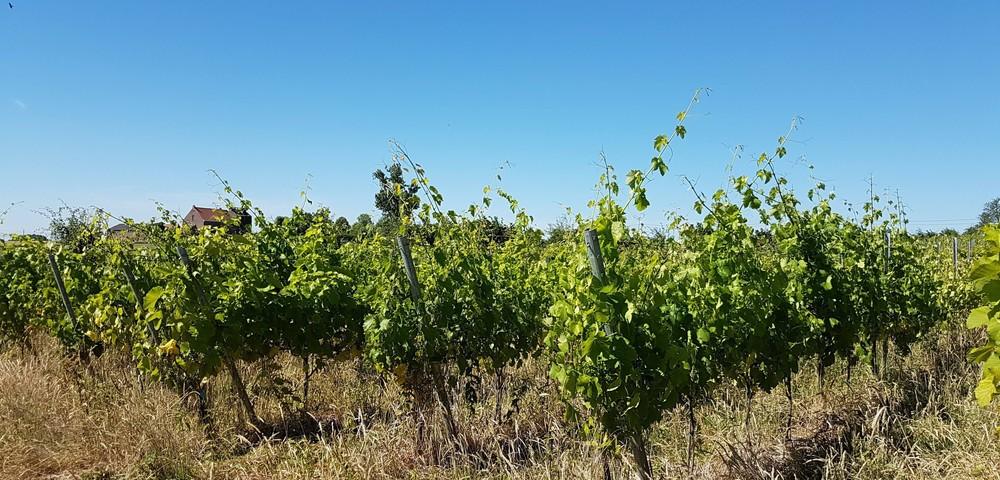
At the beginning of this new year, I want to widen the frame. I want to use viticulture as a metaphor for the common good. Agroecology is strategic, social and political. It is not a niche concern for specialists. It concerns, and affects, everyone on Earth. And by “everyone” I mean all living organisms, and in some cases even the rocks beneath our feet.
Agriculture as a system that competes with nature
Modern agriculture has become a competitive system: not an activity embedded in nature, but one that fights nature. Put bluntly, we grow plants that do not naturally want to grow in a given place, and we then have to suppress every force that would otherwise dominate, simply to make room for our target production.
The pioneer logic behind wheat
Over time, we learned something remarkable: grasses can produce extraordinary yields. Wheat, a type of grass, has been bred by humans into what is now the world’s most important staple. But to make wheat germinate uniformly and at scale, we have to recreate the conditions of its “home” biotope. A key ingredient is disturbed soil. Wheat is an annual pioneer plant: one season, one life cycle, seed at the end, then the next generation. That means the right conditions for germination have to be recreated every year. If you sow into grassland, or too deep, you do not get adequate emergence and the crop fails to deliver. The “right” conditions, in practice, are disturbed, bare soil. Hence the yearly preparation of a so-called seedbed: harrowing and shaping the ground so wheat can germinate en masse.
“Weeds” are an artefact of disturbance
But there is an obvious consequence: countless other seeds also germinate under those same conditions. Other pioneer species. In nature, pioneers exist for a reason: to cover bare ground as quickly as possible with living tissue that photosynthesises (turning sunlight into carbon chains, the basis of all biochemistry). Mosses can do this even on stone. In arable farming, those other pioneers become “weeds”. Yet many of them would never germinate without the farmer’s disturbance. Poppies are a classic example: they flowered profusely “In Flanders Fields” after the First World War because the soil had been massively disturbed. Their seeds can lie dormant for decades, waiting. In nature, such disturbance is sporadic: landslides, wild boar, and other disruptions. In arable systems, disturbance becomes planned and annual. Species such as annual meadow grass, blackgrass, cleavers and dead-nettles benefit from that rhythm, and they are exceptionally well adapted to survive it.
Rotation evolved, disturbance remained
If the same crop is repeated year after year, another problem appears: diseases and pests establish themselves: fungi, nematodes, and more. Historically this drove the development of crop rotations, including the medieval three-field system: winter cereal, then a summer crop, then fallow. Today we use more sophisticated rotations, but one thing largely remained: soil disturbance. To control weeds, the disturbance became deeper and more aggressive. Ploughs began to invert soils down to roughly 30 cm.
6,000 years of tillage and the road to desert
We have been doing this, in one form or another, for around 6,000 years. The effect is cumulative: soil life is systematically undermined until the soil loses cohesion. The speed varies by region. In temperate areas such as the Benelux, the damage takes longer to show. In semi-arid regions such as the Mediterranean, it shows quickly. The end point is stark: desert, where only parent rock remains and organic matter has been stripped away by water and wind. Mesopotamia, the “land of milk and honey”, the Sahara, and increasingly the Iberian Peninsula are all part of this story.
Erosion makes deserts, vegetation makes rain
Deserts are therefore not simply a “climate” outcome. They are an erosion outcome. It is not that rainforest exists because it rains; rather, it rains because rainforest exists. Large tree masses release particles that help moisture condense, producing precipitation. There is always moisture in the air; vegetation is the vehicle that brings it down.
Soil carbon: when farming becomes emissions
This is why arable farming matters in the climate context. More than that: working soils oxidises carbon. Soil carbon becomes CO₂ and enters the atmosphere. Over the last 200 years, arable soils are estimated to have lost 20–60% of their carbon content, and the process continues until the soil reaches a breaking point. Greenhouse gas emissions in the EU
The brown water nobody talks about
We can see this playing out in everyday life. Yet we behave as though we are living in “The Emperor’s New Clothes”. Floods are routinely presented as the result of heavy rainfall. Hardly anyone comments on the colour of the water.
What no-till changes in practice
We have worked without tillage for more than ten years, precisely to rebuild natural soil cohesion. Where fields used to sit wet, we now have excellent water management: a much higher water-retention capacity, paired with markedly better drought resilience. After 50 mm of rain over a few days, we have no issues. Nothing runs off at the bottom of our slopes. And if some water cannot be absorbed, what leaves the field is clear.
Clear rivers versus coffee-brown rivers
That matters, because clear water behaves differently from water loaded with soil. A turbulent river running clear exerts less destructive force on its bed and on infrastructure (walls, bridges) than a river running coffee-brown. A brown river is a self-feeding monster: its sediment load makes it scour harder, pick up more material, grow more powerful, and ultimately tear through streets and neighbourhoods.
The real issue is not rainfall
And it is hard to ignore what happens around us. Colleagues who farm with conventional tillage lose topsoil with almost every heavy shower. Streets fill with mud. Ditches have to be cleared with excavators. So the core issue is not rainfall. It is erosion.
The emperor has no clothes
We urgently need to treat soil as what it is: a complex living organism. Much of modern farming has become a kind of substrate cultivation: about 30 cm of “working layer” above an impermeable plough pan. Until we address that, many other climate measures remain marginal. It is like mopping the floor while the tap is still running—literally. It is time to acknowledge what is in front of us, however uncomfortable it may be for those operating in this sector on which life depends: the emperor has no clothes.
What good are candle and spectacles if the owl refuses to see? I wish everyone an enlightened year.