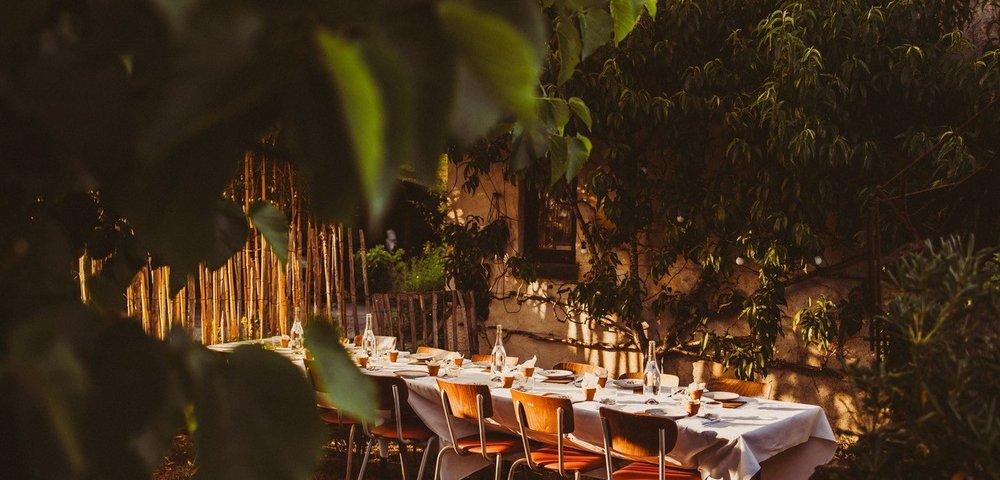
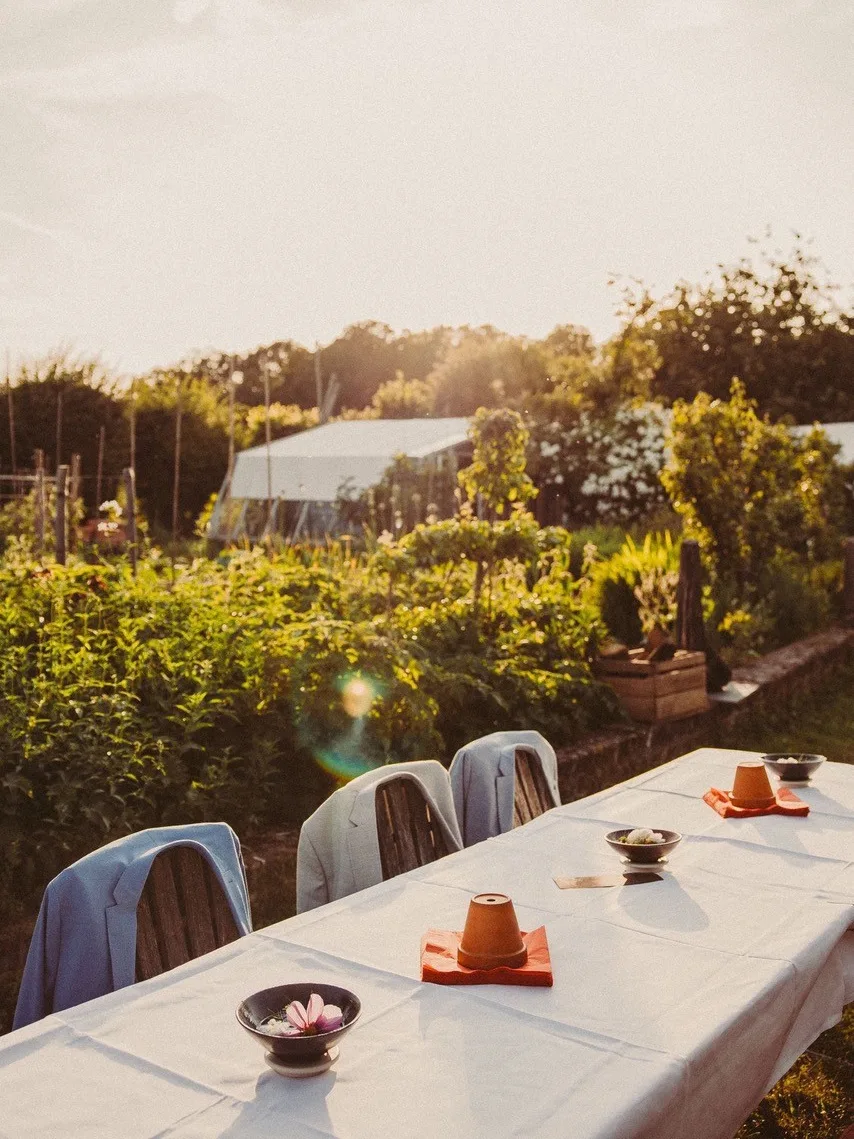
On a Wednesday evening in July, somewhere between seven and seven-thirty, the first guests take their seats at De Keukentafel in Landskouter. The light hangs low over the Aalmoezenijebos and falls diagonally across the vegetable garden they have just walked through. Where the dining room begins in other restaurants, here stands one long wooden table. No two-seater by the window, no table for four secluded in a corner. One table, twenty chairs, and the agreement that you will sit next to someone you do not know.
For some guests, it is the first surprise of the evening. For Anna and Jozefien Wynants, it is the premise upon which everything that follows is hinged.
A piece of furniture with an opinion
The two sisters opened De Keukentafel in October 2021. Anna in the kitchen, Jozefien in the dining area and behind the botanical drinks. From the very beginning, they chose that one long table, and that choice is not decorative.
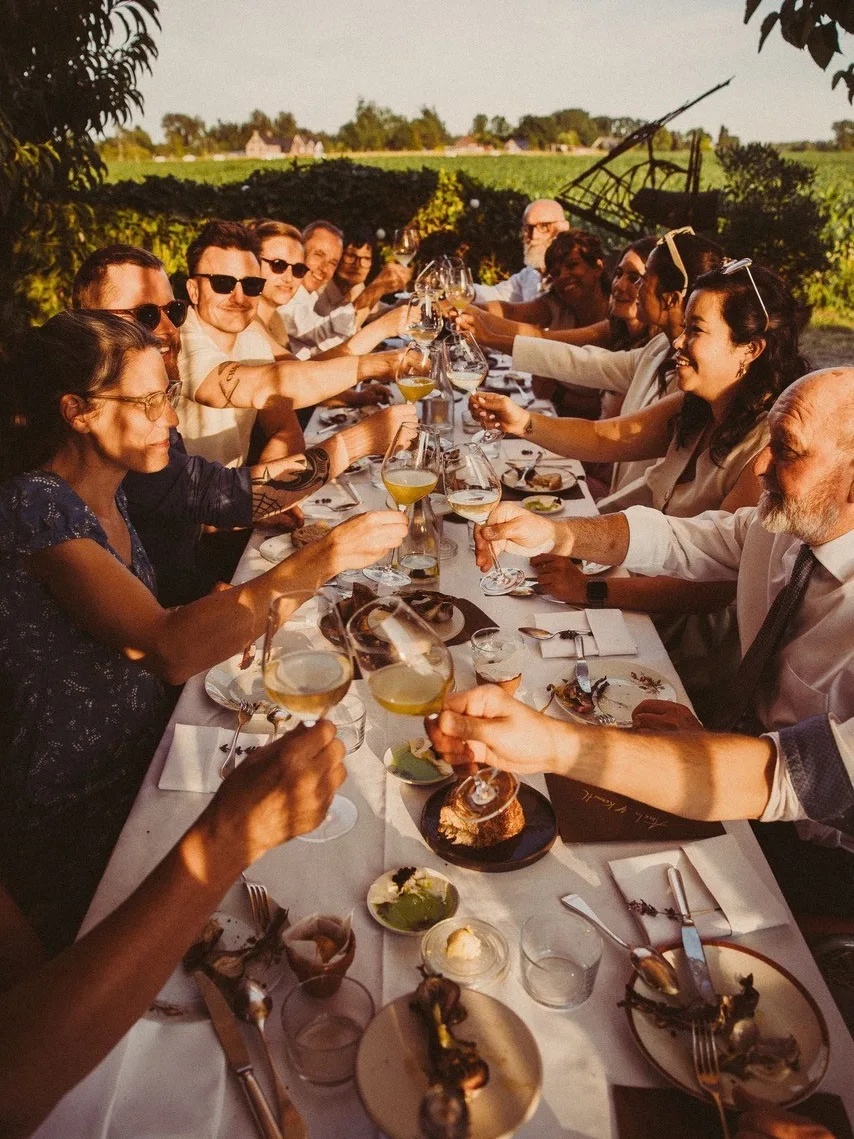
In a classic restaurant, you sit opposite your dining companion. The architecture implies a closed conversation, a world of its own for the duration of the meal. At De Keukentafel, you sit next to each other, and therefore also next to someone else. During an aperitif, your dining companion on the left gets to know the architect she notices in passing; during the starter, someone on the right is suddenly talking to a Brussels doctor about fermentation; halfway through the main course, the entire table knows who comes from where and who is there for the first time.
That is not a byproduct. It is the design.
In a world where eating increasingly takes place at home, alone or in front of a screen, sitting down together at a shared table is no longer a given. The sisters have built their business around this act. The rest, the menu, the service, the season, adapts to what a long table makes possible.
What the kitchen says
Anna cooks whatever came from the vegetable garden that morning. The vegetables are mainly homegrown, harvested fresh that day, with the exceptions for which the garden has no answer: a lemon, sometimes some mushrooms. The menu is largely decided during the course of the day, not weeks in advance. What ends up on the plates that evening is whatever the season provides at that moment.
That sounds simple. It isn't. Working without a fixed menu requires deep technical mastery, because you have to be able to switch to the technique the product requires. A celeriac can be in a salt crust today, in a fire tomorrow, and the day after tomorrow shaved raw under a dressing. Anna's kitchen relies on the kind of traditional techniques that take time. Ferments and brines that sit for days or weeks before they are ready. Sourdough that breathes at night. A morning miso butter that becomes soft and salty through patience, not speed.
The effect of this, viewed from the table, is that every plate is an honest version of that day. If a crop fails, something else is on the menu that week. If the weather was unfavorable, the harvest comes from preservation techniques designed specifically for such moments. The menu does not lie. What is available that day is what you get.
What the glass says
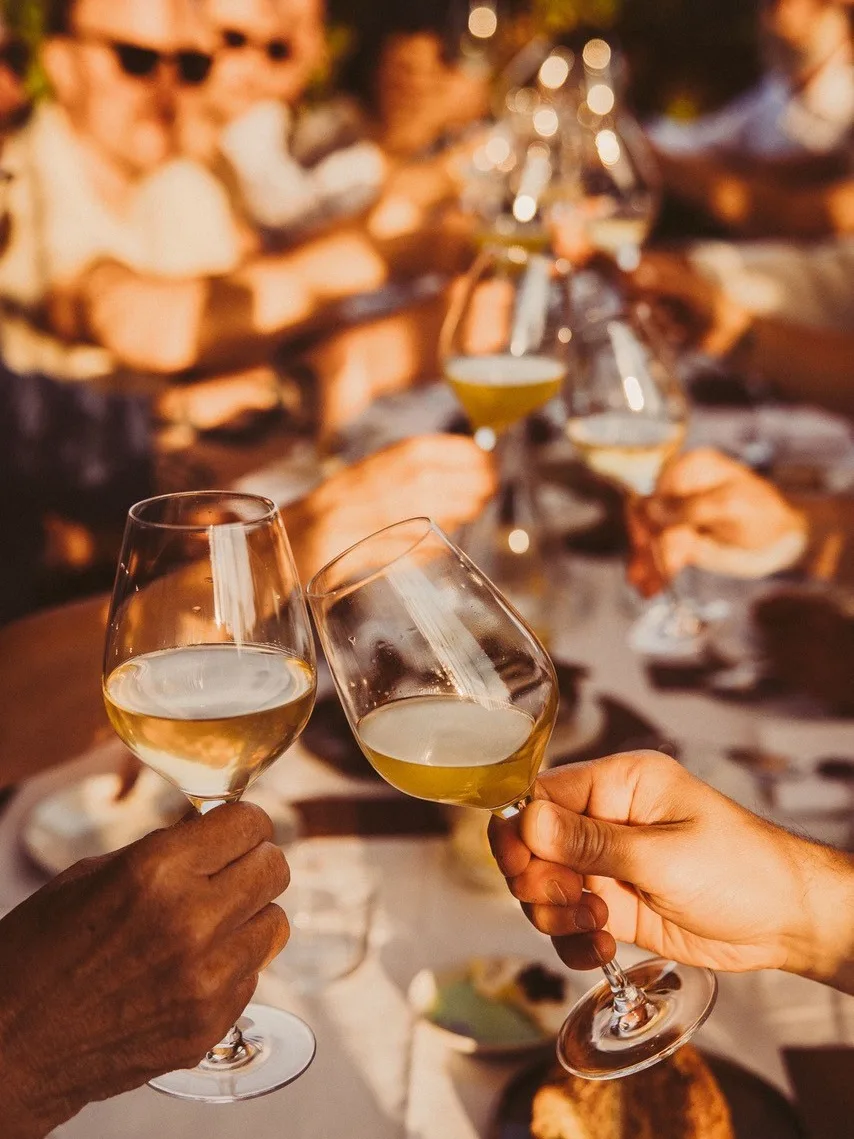
Alongside the dishes, a second line accompanies them, and that belongs to Jozefien. She has built the drinks menu around botanical, often alcohol-free pairings: cold infusions, macerates, fermented drinks, and tea extracts that change aroma over the course of a meal. For those who do drink wine, there are natural wines on the menu, along with a few Belgian organic bottles whose terroir is recognizable.
The remarkable thing is what those drinks do at the table. An alcohol-free pairing by Jozefien forces people to talk about taste rather than alcohol content. Someone remarks that an infusion is salty, someone else tastes something floral, and suddenly half the table is leaning over their glasses to try the same thing. What would be an individual tasting in a classic restaurant becomes a collective reading moment here.
The vegetarian starting point, with exceptions
The basic menu is vegetarian. Vegetables, herbs, and edible flowers take center stage, not as side dishes or alternatives. The ecological arguments for this are well known, but there is also a social logic behind it that suits the long table. A vegetarian meal is easier to share, easier to follow for those who don't eat certain things, and easier to build around the season rather than scarcity.
Anna likes to use meat or fish as a spice rather than an ingredient. A smoked jus, a piece of cured ham that imparts flavor to a stock, a sliver of fish that adds a vegetable accent. It does not take center stage, but contributes something that a purely plant-based course sometimes cannot manage on its own. Additionally, once a season, the sisters organize a Meat Feast with other chefs at the grill, where a fully organic animal is processed according to the nose-to-tail principle. Nothing goes to waste. It is explicitly not a weekly menu, but an event with its own logic: meat is allowed, the sisters believe, provided it is consumed in the right amount and with the right responsibility.
What a table does to an evening
Around ten o'clock, when the plates are largely empty and the first guests begin to think about the bike ride or the car home, something has happened that is hard to put into words. The twenty people at the table haven't become friends, but they are no longer strangers either. Someone exchanges numbers with the person at the table on the right. Two couples agree to see each other again in October. A single guest, who was somewhat hesitant upon arrival, leaves with six new conversations in his head.
That is what the design does. It obligates nothing, but it makes something possible that rarely happens in an isolated two-seater. The long table is neither folklore nor a gimmick. It is a spatial decision that says: eating is something that lies between people, not for people alone.
A business with its geography
In the winter, De Keukentafel closes for regular dinners. The vegetable garden is given a rest, the seasons are respected, and the sisters shift their work to private dinners, catering, and workshops on sourdough, fermentation, and botanical drinks. In this way, the business continues to breathe with what the land does, rather than working against it.
Whoever returns in May finds the vegetable garden planted again, the table set up under the summer air, and the same principle in operation. Twenty chairs, one table, and the silent assumption that the guests might not know each other when they take a seat, but that by the end of the evening that will no longer be entirely true.
It is not a complicated concept. It is a piece of furniture with a vision attached to it. And it works because all the other choices of the establishment, the kitchen, the glassware, the menu, the season, have aligned with that one piece of furniture.